
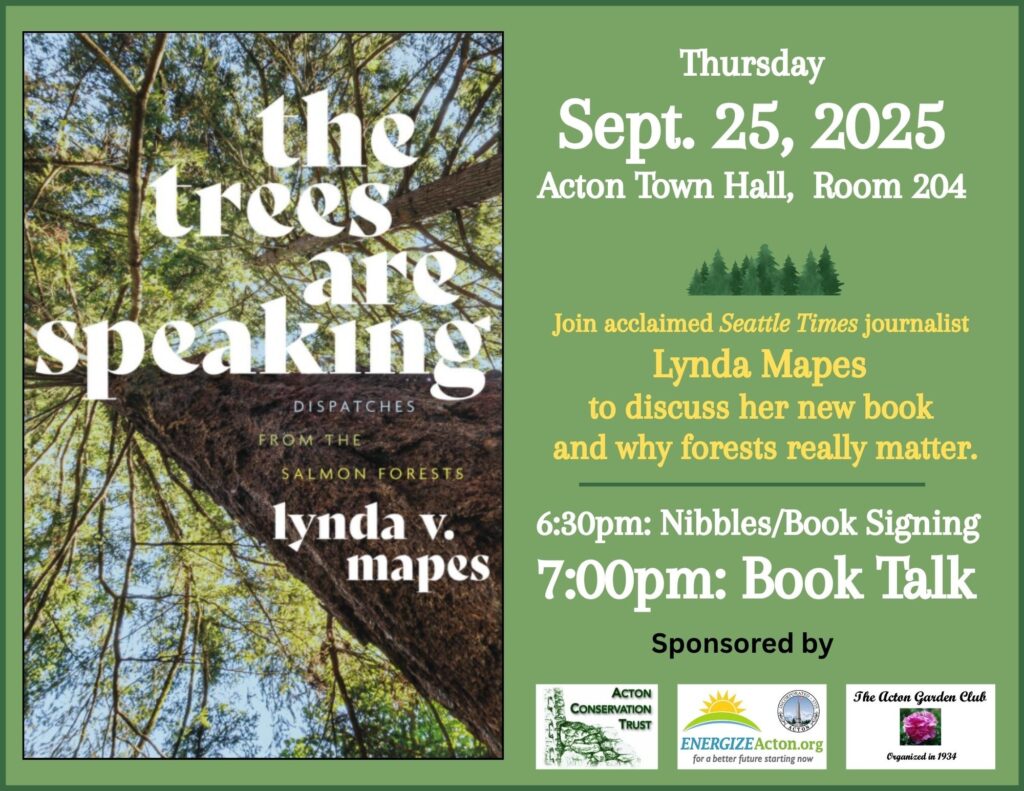

This work focuses on the critical role of forests everywhere, but especially on both coasts of the U.S., and on the role of indigenous voices in advocating for ecosystem integrity.
Do you look at your own yard and see stressed trees? Spruces dying back? Fir trees struggling? The heart-wrenching loss of beautiful beeches to beech leaf disease? What is the connection between our local trees and the health of our forests? Increasingly, we recognize the importance of forests for key ecological functions, such as clean air, clean water, important pollinator/wildlife populations, carbon storage, and a balanced climate. So how are our forests doing? And how can we advocate for trees, near and far?
Lynda V. Mapes, award-winning environmental journalist for the Seattle Times, was inspired to write The Trees Are Speaking after exploring the richness of old growth forests in the Northwest U.S. and Canada. But she also came face to face with the widespread destruction of these forests. Mapes writes, “The book therefore became a witness not only to the incredible ecological and cultural values of these forests but to the connected history of their loss, beginning on the East Coast in Maine and repeated across the United States and continuing over the border into Canada, even today.”
But not all is gloom. Mapes also outlines the resilience of nature, the insights and perseverance of First Nations people who have raised their voices to protect and renew ecosystems, understandings of our inter-relatedness uncovered by scientists, and even new approaches to commercial forestry.
These are the author, Lynda V. Mapes’ slides and audio. Her initial slide is up for quite some time, which might seem like an error, but please presevere! Lynda’s talk is wonderful! And varied slides do come up.